




How to Read an Isobar Map: Practical Guide
Have you ever seen those weather maps full of curved lines and numbers and wondered what they mean? Those are isobar maps, one of the most important tools for weather forecasting. In this guide you'll learn to interpret them like a professional.
What is an Isobar?
An isobar is a line that connects points with the same atmospheric pressure. It's similar to contour lines on a topographic map, but instead of showing elevation, they show pressure.
Basic Elements of an Isobar Map
1. The Lines (Isobars)
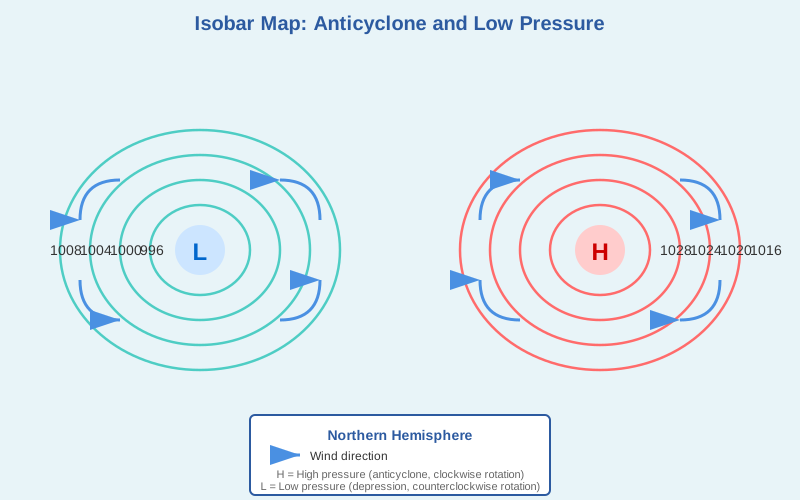
Each line represents a specific pressure value, usually with intervals of 4 or 8 hPa. For example: 1000 hPa, 1004 hPa, 1008 hPa, etc.
- Lines close together: Indicate rapid pressure change = strong winds
- Lines far apart: Gradual pressure change = light winds
2. High Pressure Centers (Anticyclones)
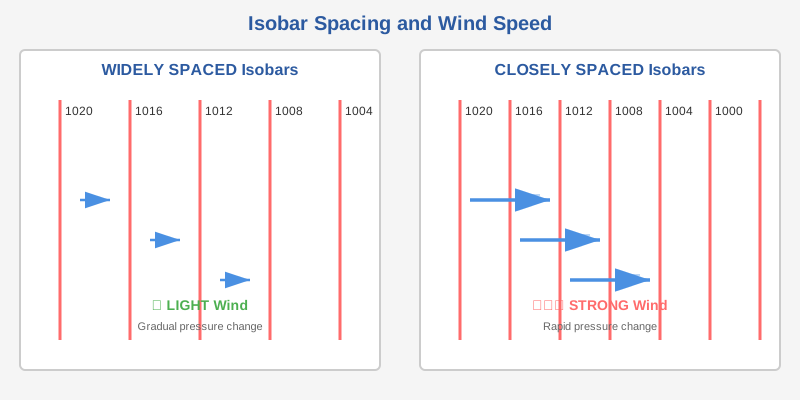
Marked with an "A" or "H" (High). The isobars form closed circles or ellipses with pressure values increasing toward the center.
- Pressure above 1013 hPa (often 1020-1040 hPa)
- Stable and clear weather
- Weak winds
- In summer: heat; in winter: cold nights and fog
3. Low Pressure Centers (Depressions or Cyclones)
Marked with a "B" or "L" (Low). The isobars also form closed circles, but with values decreasing toward the center.
- Pressure below 1013 hPa (sometimes less than 980 hPa)
- Unstable weather: clouds, rain, storms
- Moderate to strong winds
- Overcast skies
How to Forecast Weather Using an Isobar Map
Step 1: Locate Your Position
Find your city or region on the map. In our case, Seville is in southwestern Spain.
Step 2: Identify Pressure Systems
Look for anticyclones (A) or low pressure systems (L) near your location or approaching.
Step 3: Observe Wind Direction
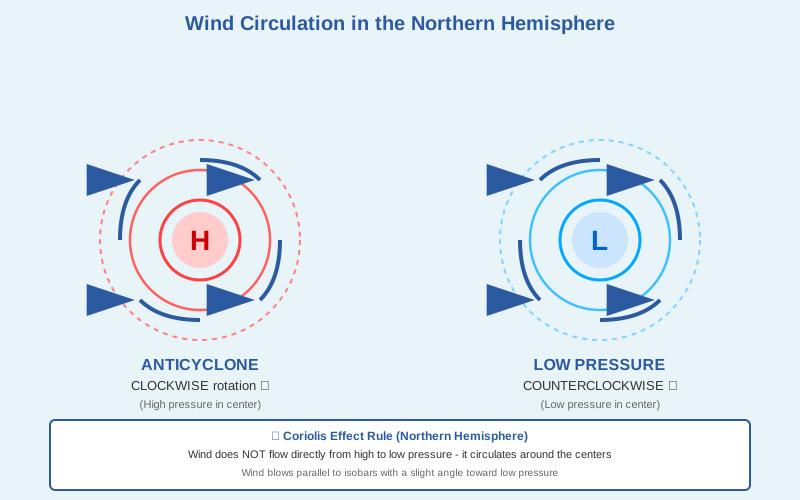
- Around an anticyclone: Clockwise (Northern Hemisphere)
- Around a low pressure system: Counterclockwise (Northern Hemisphere)
Step 4: Assess Wind Intensity
The closer the isobars are together, the stronger the wind. If you see very tight isobars, expect strong winds.
Step 5: Analyze System Movement
Forecast maps show how systems will move. Generally, in mid-latitudes (like Spain), systems move from west to east.
Practical Examples for Seville
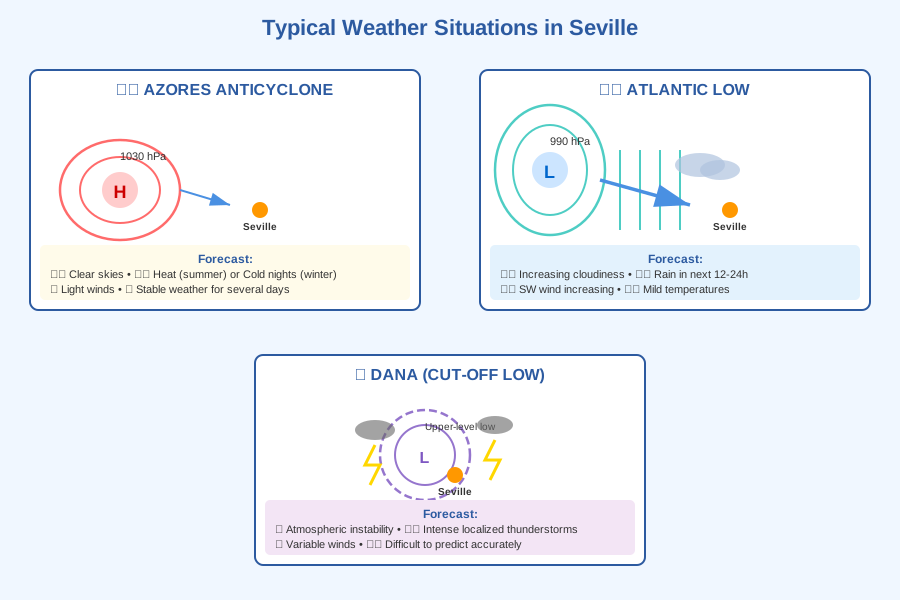
Situation 1: Azores Anticyclone
Map: Anticyclone centered over the Azores (1030 hPa) with isobars extending over the Peninsula.
Forecast for Seville:
- ☀️ Clear or partly cloudy skies
- 🌡️ High temperatures in summer, cold in winter
- 💨 Light winds
- ⏰ Stable weather for several days
Situation 2: Approaching Atlantic Low
Map: Intense low west of Galicia (990 hPa) with very close isobars.
Forecast for Seville:
- ☁️ Increasing cloudiness
- 🌧️ Rain in the next 12-24 hours
- 💨 Southwest wind increasing
- 🌡️ Mild temperatures (Atlantic air entering)
Situation 3: DANA (Cut-off Low)
Map: Small upper-level low over southeastern Spain, no clear fronts.
Forecast for Seville:
- ⚡ Atmospheric instability
- 🌩️ Possible intense and localized thunderstorms
- 💨 Variable winds
- ⚠️ Difficult to predict accurately
Common Mistakes When Reading Isobar Maps
- Thinking wind goes straight from A to B: Remember the Coriolis effect, wind circulates around pressure centers.
- Ignoring isobar spacing: It's as important as the absolute pressure values.
- Not considering local topography: Mountains modify wind flow.
- Forgetting the season: An anticyclone brings heat in summer, can bring frost in winter.
Additional Resources
- Compare maps from different times to see evolution
- Use models like ECMWF or GFS for multi-day forecasts
- Combine isobar analysis with satellite imagery
- Follow professional forecasts to check your analysis
Conclusion
Reading isobar maps is a skill developed with practice. Start by observing daily maps, identify pressure systems, and then check what weather actually occurred. Over time, you'll be able to make increasingly accurate forecasts.
The key is understanding that atmospheric pressure governs weather: anticyclones bring stability and low pressure systems bring changes. Everything else (wind, rain, temperature) are consequences of these pressure systems.
💡 Final tip: Don't get discouraged if it's difficult at first. Even professional meteorologists study several maps and models before making a forecast. Meteorology is part science, part experience.
Was this guide helpful? Check our daily weather forecasts for Seville.
Meteoensevilla.es - Weather Education Center